|
Contributed by Sharon Short & The Clark Co., Wisconsin History Buffs
History
“...At that time, 1838, all of the territory now comprising Clark Co was held by Indian tribes. The Winnebago’s, Chippewa’s, Sioux, and Menomonie’s; all four tribes claiming territory along Black River within the present boundaries of Clark Co. The Winnebago’s claimed territory east of Black River and north as far as the present line between townships 25 and 26. The Chippewa’s claimed west of Black River, the southern boundary of their claim extending westward from Black River along a line roughly corresponding to the southern boundary of township 26. The Menomonie’s claimed the territory extending west of the Wisconsin River to Black River, this overlapping and extending north of Winnebago territory. The Sioux claimed all that territory; from the mouth of Black River on its western border to a point half a day’s march south of the Falls of the Chippewa’s. That left a part of western Clark Co neutral territory not specifically claimed by any tribe, but hunted and trapped by all of them. The Indian tribes were very hostile to any settlement or logging operations upon their territory and kept that rein on outsiders until 1837. In 1837 treaties were made with the Sioux, the Chippewa and the Winnebago’s by which they ceded all their territory in Wisconsin to the United States. Those treaties however left the Menomonie claim unsettled but as their agency was on the Wisconsin River they only visited the Black River valley for the purpose of hunting and trapping until the winter of 1843-1844 when Chief Oshkosh and some other members of the tribe came to Black River Falls and forbade further logging up on the Black River... In 1847 the Menomonie released their claim to this territory and the government survey commenced....” History of Logging in Clark County By Dee Zimmerman Clark County Press
“...The Indians inhabiting the county were principally Chippewas. The dividing line between that tribe and the Winnebagos on the south was nearly at the confluence of the East Fork with the Black River. They received the new comers in a friendly spirit, and as settlers began to come in, brought peltries to sell or exchange for pork and flour. They excelled the Winnebago's in cleanliness and intelligence, were neither vicious nor dangerous, though given to stealing, and it was the boast of their chief that none of his tribe ever shed the blood of a white man or his family....” The History of Clark Co., WI 1881 Transcribed from Pg. 227 - 252 "The History of Northern Wisconsin" by Janet Schwarze
INDIAN TROUBLES IN WISCONSIN 1862-1863 “...The 1862 trouble centered in Juneau County. Concentrating here, the Winnebago not only gathered wild berries and peddled them to white farmers but also begged, entered houses to demand provisions, threatened housewives, grazed ponies in grain fields, and otherwise annoyed and intimidated the whites. General Pope planned to send troops for removing the Winnebago from the state, but the acting commissioner of Indian affairs, after consulting the secretaries of interior and war, refused to co-operate, protesting that the Indians in question were “old residents of Wisconsin” and that the Indian bureau had “neither agent nor money to take care of these Indians.” “...In July 1863 a party of Winnebago visited the farmhouse of George Salter, six miles north of New Lisbon, while he was away. (George Salter’s business, to a large extent, appears to have been to furnish the Indians with whiskey.) He returned with his children to find the house ransacked and his wife dead. She had been badly beaten, her throat had been cut, and she had apparently been raped. When a drunken Indian appeared near the house, Salter killed him, and a German neighbor took a grub hoe, cut off the dead Indian’s head, and stuck it on a pole. When another Indian came by, Salter beat him to death with an axe handle. About two weeks after Mrs. Salter’s death, another Juneau County farm wife nearly suffered the same fate. Mrs. J. Austin was at home with her two small children, five miles from New Lisbon, while her husband was at work in the fields. She locked the door when Indians approached, but the broke in through a window, attacked her with knives, and attempted to seize the children. She barely managed to fight off the intruders with a rifle and with the aid of a large dog, which was seriously wounded.” “...General Pope dispatched to New Lisbon a company of the thirtieth Regiment, for the protection of the Indians as well as the whites. The military also arrested several Winnebago leaders, including Chief Dandy, and held them “more for their own protection against the excited white settlers than for any crimes or depredations.” While under arrest, Dandy told Indian Agent Davis he would be willing to turn over Mrs. Salter’s murders to the white authorities but could not do so until he had been freed. After his release he talked with (Wisconsin Governor) Solomon and gave assurances for the good behavior of his tribes people. By summer’s end in 1863 a relative calm had returned to the New Lisbon area. As the hunting season began, the Winnebago-perhaps 1,000 men, women, and children altogether—broke up as usual into several small bands under chiefs Dandy, Caramonee, Little Snake, Dekorah, Yellow Thunder, and Indian Jim. These bands were scattered over a distance of seven-five to 100 miles, from Wood County through Juneau, Sauk, and Columbia...” The History of Wisconsin Volume II by Richard N. Current page 322-323
YELLOW THUNDER, WINNEBAGO CHIEF
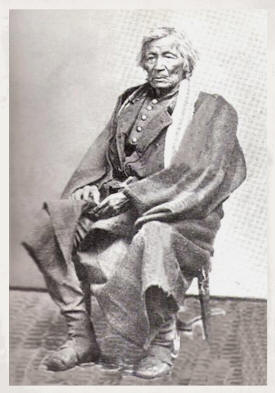
Chief Yellow Thunder
“A few Winnebago, those who owned land and lived on it in more or less the manner of the whites were well accepted and even highly respected by their white neighbors. Outstanding among these few was Chief Yellow Thunder. Along with the rest of his tribe he had been forcibly removed to the west of the Mississippi River in 1840, and like many of his fellow tribesmen he had returned as soon as he could, he and his wife walking nearly 500 miles. On his return he bought forty acres in northeastern Sauk County, built a log house on his land, and settled there with his wife. After his wife’s death in 1868 he seldom stayed in the log house, but lived most of the time in a tent that he pitched near the Wisconsin River. Tall, stately, he dressed much like a white man except for the inconspicuous black ribbon ornament in his hair and the blanket he wore in resentment on account of the dispossession of his people. In the fall of 1873 a knee injury led to blood poisoning for Yellow Thunder, and his white neighbors helped to care for him in his final illness. Before he died the federal government made another attempt to remove the Winnebago from Wisconsin.
Ever since the Indian troubles of 1862 (by the Sioux Indians in Minnesota), whites in Wisconsin had been demanding the removal of the Winnebago. Finally, a regiment of infantry was sent from Fort Snelling, in Minnesota, to round up the stray bands and take them to Nebraska. A few days before Christmas, 1873, about 150 of the Indians were encamped along the Baraboo River, between Baraboo and Portage, for a powwow. A company of troops broke up the party, herded the people to Portage, and put them aboard a train. Yellow Thunder and other landowners were exempted from the removal drive. All together, about 860 Winnebago were transferred, with much hardship, to the Nebraska reservation, where they were not welcome and where they did not want to be. Within a few months, more than half of them were in Wisconsin again, and thereafter others kept trickling back.” The History of Wisconsin, Volume II, page 558-559, George W. Thatcher, “The Winnebago Indians, 1827-1932” Master’s thesis, University of Wisconsin, 1935
PLAT MAPS
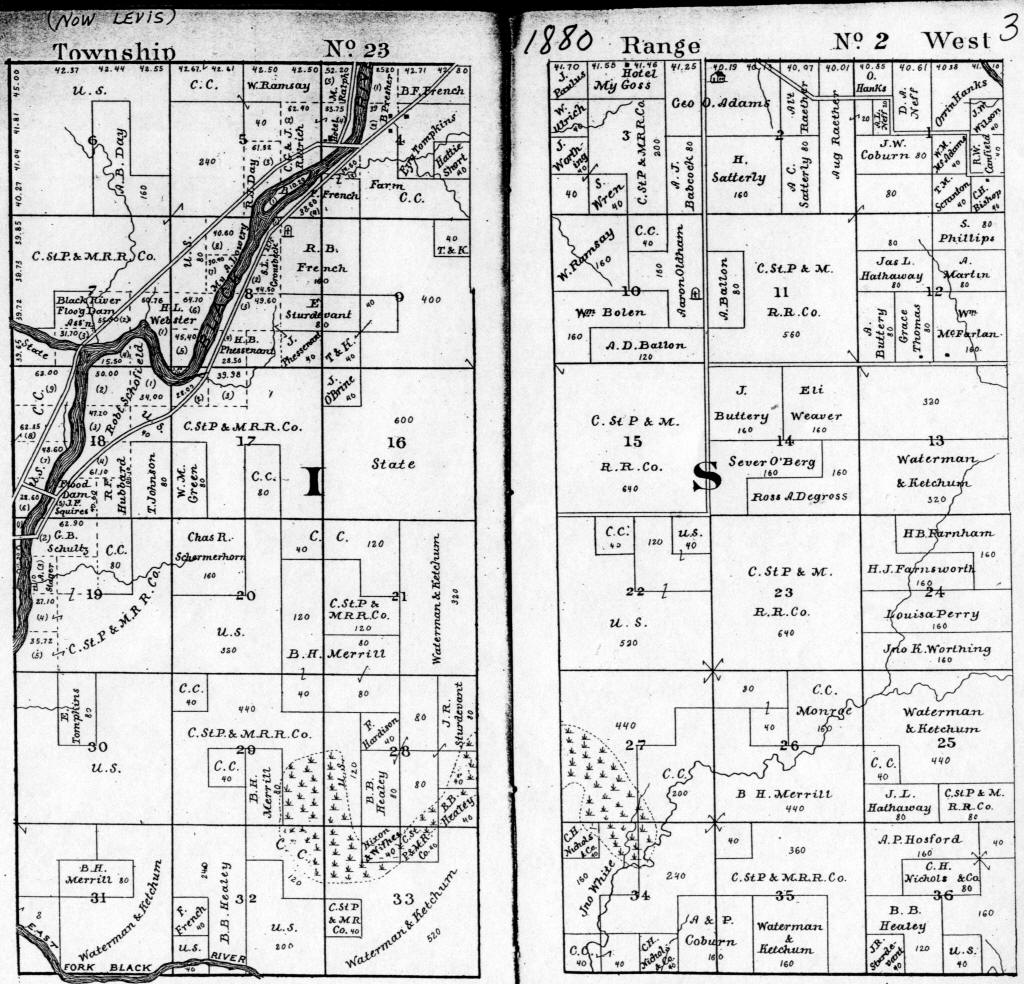
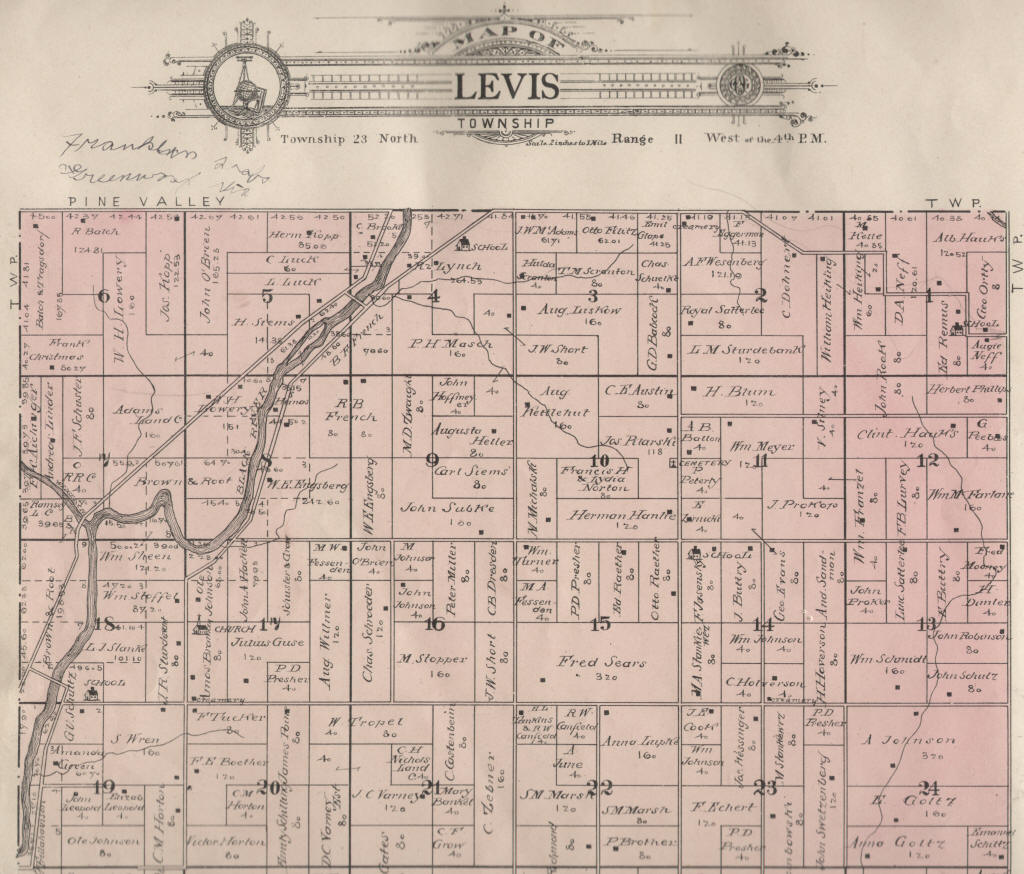
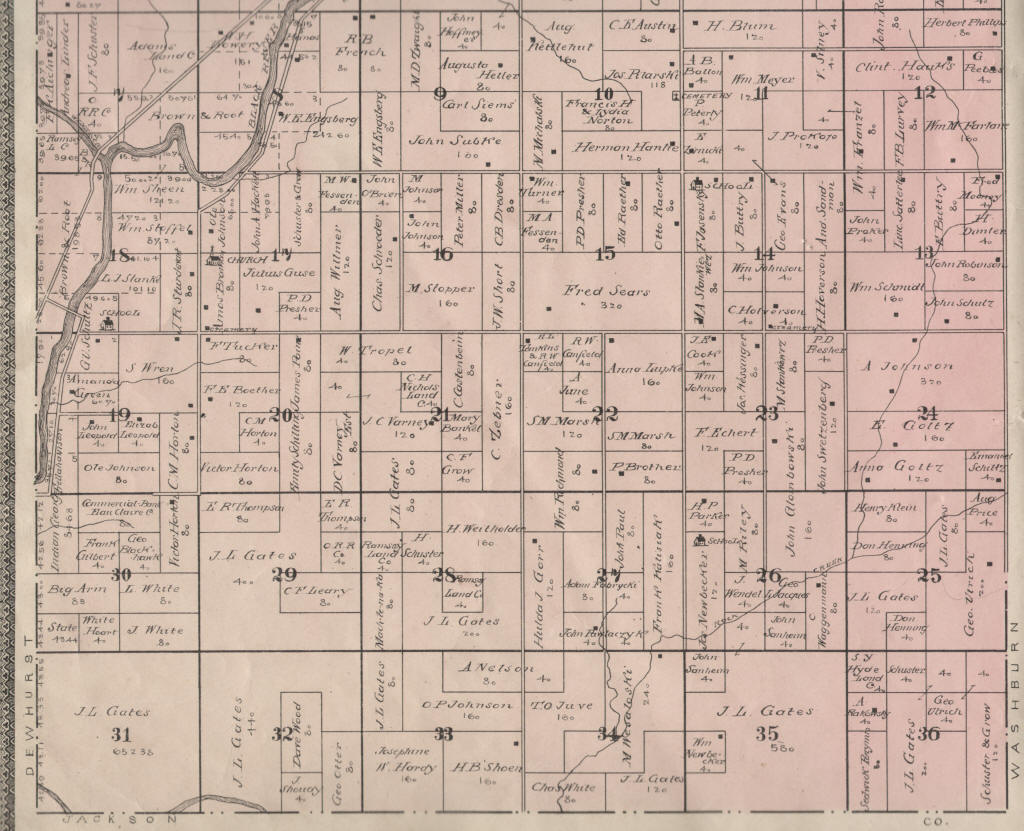
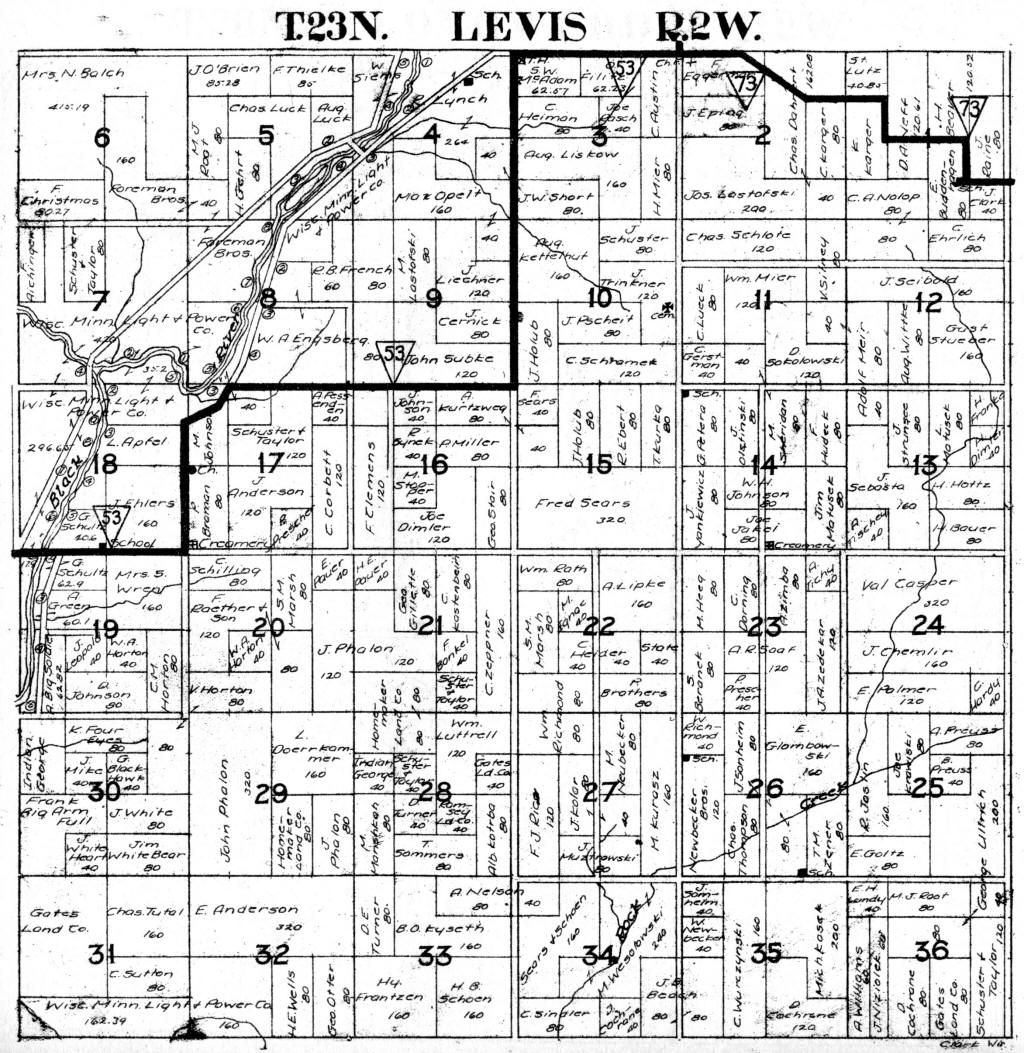
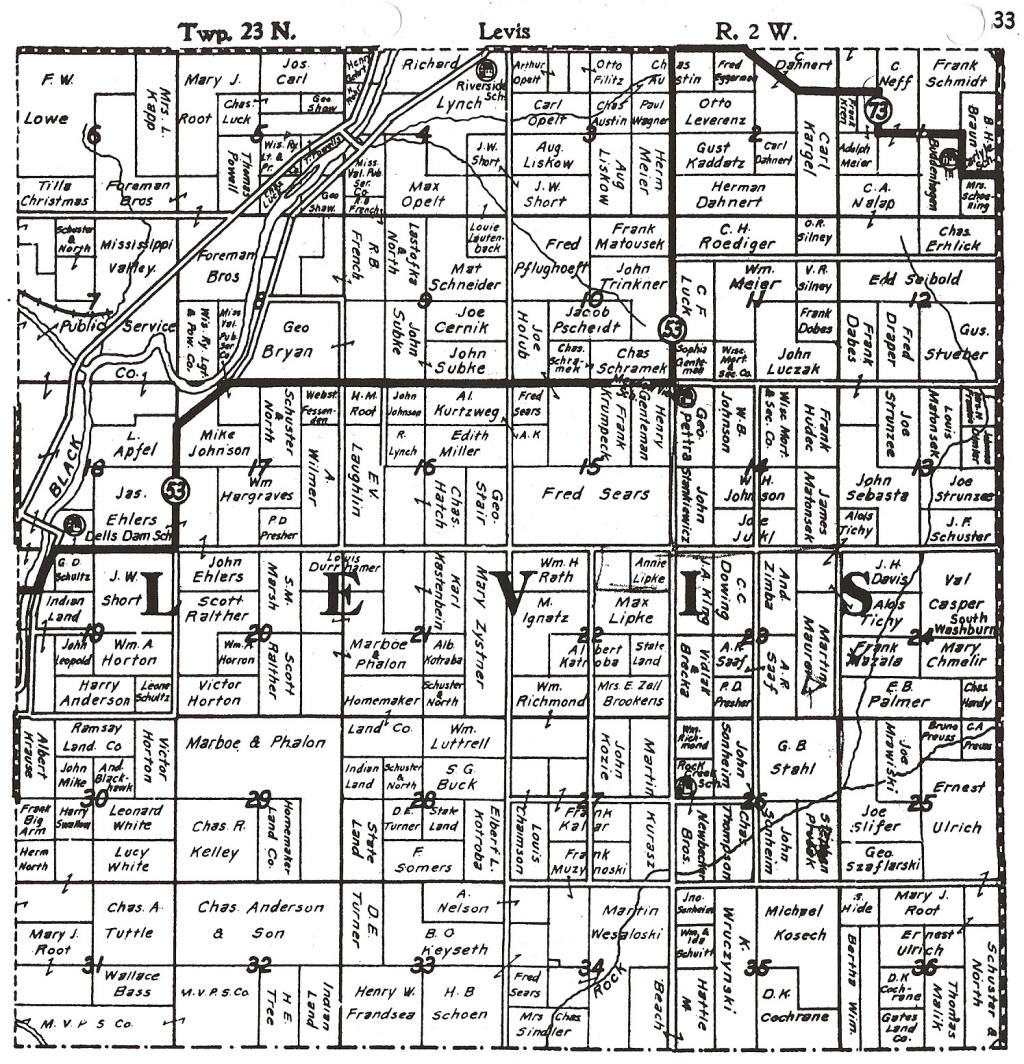
Levis Township Plat MapsTownship 23N, Range 2W Clark County, Wisconsin
[First Owners] [1880] [1893] [1906N] [1906S] [1915] [1920] [1926] [Soil Map]
There were and still are properties in many of the Clark Co townships simply listed as “Indian Land”. The Clark Co townships (Dewhurst, Levis, Washburn, Sherwood) along the northern border of Jackson Co (location of the Winnebago Indian Reservation) was the logical location of those Indian families wanting to be close to but not living on the Reservation.
Name Date Transaction Parcel Sec Land Office Accession/SN Document MIKE, JOHN 8/19/1909 Homestead SENW 30 Wausau 76175 0588 (First Owner’s Maps research and production by Chuck Debevec)
1893: Section 28--J L Gates, Ramsay Land Co, H Stoefel, AH-KA-KA, MACH-TE-NA-KA Section 30--MAU-TIS-A-KA, Wm Joe, G. Blackhawk, T Gilbert, Indian George, White Heart, U S, Jim White, L White
1906: Section 30—Indian George, George Blackhawk, Frank Gilbert, Big Arm, White Heart, L. White, J. White, Victor Horton, State, Commercial Bank of Eau Claire
1915: Section 30—Indian Land, J. Big Arm Full, Victor Horton
1920: Section 19—A. Big Soldie (?), A. Green, (plus “whites”) Section 28—Indian George, M. Mahshkeh, (plus “whites”) Section 30—Indian George, Frank Big Arm Full, K. Four Eyes, J. Mike, G. Black Hawk, J. White, Jim White Bear, J. White Heart, V. Horton
1926: Section 19 and 28—Indian Land (plus “whites”) Section 30—John Mike, And. Black Hawk, Frank Big Arm, Harry Swallow, Leonard White, Lucy White, Herman North, Albert Krause, Victor Horton
Pre 1907 Marriage, Birth, Death, Indexes
A license was required for “white” marriages but apparently not for Indian marriages. Births, regardless of race, were not always reported and many reports were delayed until the need for a birth certificate arose. Death certificates were required prior to burial for “whites” but not for Indians according to the cemetery records. A search of the on-site information revealed the following Indians on the Clark County, WI pre-1907 indexes.
Marriage Index Name of bride and groom Marriage date page vol Stacy, Minnie & Younger, Andrew 16 Jan. 1876 93 1 Stacy, Victoria & Parkhill, William L 16 Jan. 1876 93 1
Birth Index Surname First name Birthdate Reel Image Winnebago 15 Jan 1884 30 2625 Winnebago Echo M 23 Apr 1903 31 2837 Winnebago Migtle B 07 May 1905 32 1072
Death Indexes Surname First name Death date Vol Page Stacy, Emery August 15, 1899 3 52 Stacy, Fred August 17, 1903 3 176
Newspaper Clips 1856 - 2007
1856: In 1856 two men, Pettengill and Page, fur traders, had a dispute with some Indians and held a grudge. Some time after, when Pettengill was stopping at George Huntzickers, who kept a "Lumberman’s Home" he was informed that one of these Indians was outside. Pettengill stepped out on the porch and from there shot the Indian dead, who lay all night where he had fallen. In the morning men dragged the body to a nearby hole made by a windfall, uprooted tree. The tree was sawed off which let the stump fall back, burying the body. Those at the "Lumberman's Home" spent a night of anxiety, fearing what the Indians might do, though nothing was done and Pettengill succeeded in eluding justice. The Hub of Clark County (1853 - 1934) (Also see “Pioneer Settler’s Memories” regarding the Pettengill story)
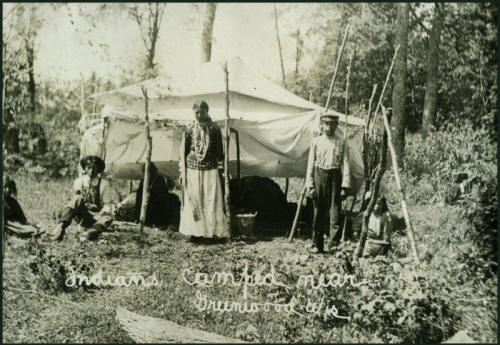
Indians Camping Near Huntzicker's Woods, 1917 ca. (Click on the photo to enlarge it)
July 28, 1868: Our village has been frequently visited lately by a number of Pottawatomie Indians. They have an encampment now on Wedge’s Creek. Some of them have been from house to house asking for food. This was a few years ago the hunting gounds of the Chippewa and the presence of a Pottawatomie at that time in this vicinity was sure death to a “Potta”. Clark County Press
October 1868: Within the past few weeks our county has been literally swarmed with Indians composed mostly of Pottawatomie, some Menominee and Chippewa. Their object here is to hunt and trap. Recently, they were driven from Wood County and they have now taken refuge here. A meeting was held at the courthouse yesterday to consider the problems in feeding the Indians. They have been digging potatoes from area gardens, picking corn from the fields, catching chickens, etc. A peaceful solution is needed in the dilemma. Clark County Press
November 1869: The other day it was a strange sight to see a “buck” Indian carrying a papoose upon his back while walking on the streets of our town. An encouraging sign to those who advocate “Woman’s rights.” Clark County Press
January 1874: Uncle Jacob Spaulding, of Black River Falls, was in town on Saturday, with a petition asking Congress to set aside a large tract of government land east of that village, as a reservation for the Winnebago Indians who desire to remain in this state. The names of nearly 200 of the citizens of Jackson County were on the petition. The petition received the addition of many names here and we believe that a majority of the people in the two counties are in favor of the Indians remaining here. Clark County Press
1877: Last Wednesday evening, about twenty-five Indians, men and women came to town and broke the monotony of these dull muddy times. They gathered at the Firemen’s Hall and quite a number of our citizens watched the festive affair.
After their dancing, all gave Hank Meyers a hug before leaving. It was an affectionate scene and one that made quite an effect on all present. Clark County Press
February 1878: Quite a number of Indians, with their families, made an appearance in town last Monday. They also brought several ponies laden with baskets to sell, manufactured by them during the winter. Clark County Press
December 1878: Charles Pigeon, a Native American citizen of the Winnebago tribe, with a number of his fellow artists, proposes to give a dance at the Fireman’s Hall tomorrow evening. Clark County Press
June 1879: Poor old Chief Winneshiek, who, with some of his people was carted off to Nebraska by the government, is back. Winneshiek, of the Winnebago tribe, has resided near Black River Falls since he returned from Nebraska about five years ago. He arrived in La Crosse the other day, accompanied by three braves for the purpose of seeing Senator Angus Cameron. We wish him well in receiving something in the shape of justice from the government for the unnecessary removal to Nebraska. Clark County Press
January 1880: Wolfe, one of the old chiefs of the Chippewa band of Indians, is now living on the Eau Claire River, in Douglas Co. He is 118 years old, is almost totally blind and nearly helpless. He lives with one of his children. Last week, Wolfe was visited by his children, grandchildren, great-grandchildren and great-great-grandchildren. Here was the representation of five generations in one wigwam, at one time. He had seen his father and grandfather, making seven generations with which Wolfe has been acquainted. Clark County Press
October 1880: A crew of about 50 Indians is working on the construction of the Black River Railroad, between Neillsville and Merrillan. Clark County Press January 1882: Old Winneshiek, head chief of the Winnebagos, residing near Black River Falls, died December 30th aged 78 years. The old chief was well known in this region and generally esteemed for uprightness and honesty. The Indians are all in deep mourning on account of his death. He had in his possession a medal presented to his father as a token of friendship by James K. Polk, president (1845-1849) of the United States, many years ago. It was highly prized by him. Winneshiek had several times represented his tribe as a delegate to Washington, and had been present at many important Indian tribe councils in the West. He left a son, Big Fire (or Medicine Smoke) who will probably succeed him. Clark County Press
March 1883: Monday afternoon, some men drove into town, from the north, with a load of straw. They stopped in front of the North Side Hotel, lowered the body of an Indian to the ground and carried the pitiable burden into the hotel, where warmth and care were found. The Indian had become chilled and helpless. The kind-hearted gentlemen, who assisted the man, deserve praise. Tuesday morning, the Indian had recovered and was able to leave town. Clark County Press
October 1885: The Indians have been bringing in an abundance of freshly picked cranberries to sell in our village. Clark County Press
November 1885: Indians have been camping along Cawley Creek, off and on, for some time. Clark County Press
23 Nov 1888: A number of Indians were in the village last week. White Thunder, James Decorah, and James Lincoln were among them. Thorp Courier
November 1891: A number of Indians are hunting in this vicinity. Thorp Courier
March 1892: “The streets were full of Indians Tuesday, homeward bound from their happy hunting grounds, the Weston chip piles.” Clark County Press
May 9, 1894: Ed Begley has engaged a crew of Indians to work for him. Republican and Press
County News of 1895 York: Several Indians encamped here are affected with a peculiar throat disease somewhat resembling tonsillitis. Clark County Press
September 1899: Black Hawk, the most noted chief of the Wisconsin Winnebago Indians, age 90, died in the town of Brockway, a few miles from Black River Falls. The chief has been well known in the western part of Wisconsin. For the last 50 years, he was always a friend of the whites and on several occasions prevented the Winnebagos from taking the warpath to settle differences with the whites. Clark County Press
January 6, 1921: An Indian Chief's war bundle-one of the few owned by museums in the country--was recently given to the Wisconsin State Historical museum, by John Blackhawk, of Greenwood, Wisconsin, great grandson of "Winnebago Blackhawk," an Indian chief of the Mississippi River Valley tribes. Most of these bundles are kept in the possession of the family and are handed down from generation to generation. The entire bundle is wrapped first in matting and then in skin and is worth about $200. It contains several ermine, the sacred animal of that tribe, medicine, herbs of various kinds, charcoal tied in a skin bag, three war clubs, several flutes, fire-hearths and dagger sheath. The only other bundle of this kind that is in the Wisconsin Museum at the present time belongs to the same tribe but to a different clan. Owen Enterprise
September 1929: Indians, of this area, gathered on the Hemlock where they entertained visiting Indians from around the county and from other parts of the state, over the weekend. Tribal and religious rites were practiced with the usual prevalent “big feeds” of meat and seasonable vegetables. It is understood that a steer and three hogs were consumed in the three days, Saturday, Sunday and Monday. Visiting Indians were present from Black River Falls, Tomah, Neillsville, the Dells and other southern and southeastern points. It is estimated that there were at least 125 who attended the Pow wow. Clark County Press
July 1931: Some Indians living in this area are killing deer in the Tioga country. The venison is being offered for sale at 20 cents a pound and can (be) purchased in Neillsville. A new baseball team had their opener against the Pleasant Ridge team last Sunday. Adopting as their slogan, “Athletics for all,” the newly organized Neillsville Collegians made their debut. They dropped a loosely played contest, 14-6, to the fast Pleasant Ridge nine. Wade Lepke started in the pitcher’s box for the locals but wildness and poor support on the part of his teammates forced his retirement in the sixth inning. He was replaced by Bernard Little George, fifteen-year old Indian phoneme, who pitched beautiful ball the remaining three innings, limiting the opponent to one hit. Manager Marvin Eide juggled the lineup considerably in an effort to find the best combination. He finally decided on the following: Skroch, catcher; Little George, pitcher; Dick Hemp, first Base; Eide, Second base; Walter Hemp, shortstop; Gluck, third base; Rowe, left field; Lepke, center field; Schroeder, right field. Cooke and Spaete also broke into the lineup for a few innings. Clark County Press
August 1931: The Neillsville baseball team, after defeating Abbotsford 6 to 1, Sunday at the Fairgrounds, lost some of its speed and dropped the second stanza of the double header to the Collegians, 4 to 3.
Both games were well played, although the fans centered their interest in the last game in which the two Neillsville organizations were pitted against each other in a “grudge” duel, with two Indian brothers doing the hurling. Wilbur Blackdeer, for the city team, struck out nine men and Earl Blackdeer, for the Collegians, sent eight men to the bench. Little George, Skroch, Hemp and Zaeske scored for the Collegians and Zank, Bush and Weaver rounded the circuit for the city team.... Clark County Press
1932: Little George, Bernard Sophomore 1932 Neillsville High School - Administration & Students - 1932-33
July 9, 1932: The big Fourth of July celebration at Hatfield drew one of the largest crowds ever assembling there since the resort was instituted. Sunday’s progam of events was practically annulled on account of rain. The big event on the Fourth was the ball game between Black River Falls and Humbird Legion teams, resulting in a score of 10 to 7 in favor of Humbird. Jimmie Lawrence held up his reputation as a twirler, with Blackdeer as catcher. In the forenoon Neillsville defeated the Winnebago Indians in a one-sided game on a 9 to 0 score. Humbird Enterprise Newspaper April 1934: Mrs. Anna Davis, Winnebago Indian, about 80 years old, died April 5, at the home of her daughter, Mrs. Ray White, at Dells Dam. Mrs. Davis had been ill all winter. She is survived by Mrs. White, as two other daughters have preceded her in death. Burial was made in the Indian Cemetery at Dells Dam, tribal services being used. In conformity with the Indian custom, a “wake” was held, lasting four nights. On the first three nights, supper was attended by more than a dozen relatives and friends, at which tribute was paid the departed member of the tribe. On the fourth night, the group remained up all night during which several Indian veterans of World War I told of their experiences in the army. On April 6, Ray White received word that his father, of Pittsville, had died in the Tomah hospital. After attending the funeral of his wife’s mother, he left for Pittsville to attend the services for his father. Clark County Press Sept. 17,1932: Indians who have been located at the junction of 10 and B in the basket trade, are living in S. S. Andrus building. Humbird Enterprise Newspaper
August 1934: The Silver Dome baseball team played the Hatfield CCC camp team Sunday at Hatfield, winning 9 to 1. The Silver Domers are now leading the league. Later, the Pleasant Ridge baseball team defeated the Silver Dome team in a 10 inning battle, 5 to 4. The Silver Dome roster included: Thompson, Green, E. Black Deer, Decorah, Klatt, Schoenherr, Gander, White Rabbitt, Seif and Poertner. The Ridge line-up was Blackman, West, Buddinger, Roder, Hughes, Selves, Warnecke, Magnuson, and Schuelke. Clark County Press
August 9, 1934: George (Carimen) Greengrass, 81 year-old Winnebago, Indian, living at Dells Dam, was the victim of a brutal assault Friday, when an Indian, said to have been under the influence of liquor, attacked him in the yard of his home. Mr. Greengrass suffered a possible skull fracture, severe bruises to the eyes and mouth, and a terrific beating about the body. He was given treatment at the Krohn Hospital in Black River Falls and removed to the home of Pete Pettibone at Dells Dam. His condition became worse Tuesday with bleeding from the right ear, and he was brought to the Neillsville hospital and placed under the care of Dr. H. W. Housley. Mr. Greengrass says he knows of no reason for the attack. Harry Swallow, about 35 years old, has been logged in the Clark Co jail in connection with the case. Mrs. Ruth Blackhawk, 22 years old, is said to have been a witness to the attack. Clark County Press
August 1934: The discovery Monday, of an old human skeleton by Ferdinand Wittke on his land (Weston sec 28, SE corner) north of the Neillsville Mounds, brought Deputy Sheriff Herman Olson and Dr. M. C. (V.) Overman, County Coroner, scurrying to the Scene. They came to the conclusion that the bones were those of a young Indian woman who died about 25 years ago. According to Mr. Wittke, he and his son, Lester who have been building a fence along an old Indian trail, became curious of a depression in the ground near the fence line. The earth appeared to have been disturbed recently.
They obtained shovels and found the digging was comparatively easy, confirming their belief that the ground had been removed not long ago. At a depth of a little more than three feet, they came across the bones, which looked as though they had been thrown in a pile and covered up again. This gives rise to the theory that the bones had been removed from their original resting place and reburied in the secluded grave in the woods. The officials, after conducting a thorough examination of the premises and gathering all the bones together, made an inquiry at several nearby homes. At the Lester Landgraf farm, it was learned that an Indian woman had been buried in that vicinity years ago and that Linus Frank knew where her grave was situated. Mr. Frank, whose farm in nearby, informed the officers that the Indian woman, 20 years old, who was a member of a party of Indians camped in that territory, contracted tuberculosis. After a short illness she died. (This sounds like Lucy Funmaker 1895-1914, but she is buried in the Greenwood Cemetery)
She was buried a few feet off the trail that led down to Black River. Apparently someone recently dug into the grave in the hopes of finding Indian relics and they threw the bones back and covered them up. As a result of the skeleton discovery, residents of the community recalled reports of a ghostly manifestation in that area north of the mound about 10 years ago. It was rumored at that time that a mysterious blue, nebulous light was seen to rise from the ground. The light would then dance across the landscape, always returning and disappearing at the point from which it had appeared. Walter Dangers (1883-1941) declared he saw the diaphanous glow floating among the trees one night and heard what sounded like a woman laughing as the light appeared to sink into the ground. While Mr. Danger’s story was discounted at the time, he now points to the skeleton of the Indian woman as proof that there was a basis for the ghost story. Clark County Press
December 1937: About 60 hunters were in a tavern at Pray and not one had bagged a deer. While they were in the tavern, two Indian fellows drove by in an old car with two nice-sized bucks, one on, each side of the car. Clark County Press
May 1938: Flags will be placed on the graves of 652 departed war veterans in 56 cemeteries in Clark Co on Memorial Day, May 30... Bright Feather, an Indian buried in the Town of Dewhurst, was listed as an “Omaha scout” during the Civil War.... Clark County Press
December 1940: Thirty-four members of the Service Company and Company I, 128th Infantry, to which several local boys were transferred after induction into Federal Service last October, returned to their homes late Sunday for the Christmas holidays. Four others arrived a day earlier. The main contingent started out on a 10-day furlough from Camp Beauregard, La., at noon Saturday on a special train, and arrived in Merrillan about 9 a.m. Sunday, where they were met by cars, of which many were secured by Legion Commander Harry Roehrborn to transport the guardsmen to Neillsville. Those making the trip home were: Master Sgts: Claude Ayers and Francis R. Welsh; First Sgt. Harley F. Jake; Staff Sgt. Elmer R. Barr; Sgts: LaVerne Gaier, Jessi A. Mike, William E. Neville and Louis A. Zschernitz; Corps. Leonard G. Rupprecht, Thomas A. Flynn and Arthur (Stir) Wagner. Privates: Irvin Blackdeer, Wilbur Blackdeer, Edwin H. Bruhn, Willard L. Green, Gerald O. Janke, Elwood D. Seller, Clifford Blackdeer, Eugene L. Cooper, George H. Florence, Ernest M. Fremsted, George Green, Henry W. Herian, Orville R. Jake, Fred R. Marty,
William Mike, Carl F. Nauertz, Samuel H. Neuhaus, Donald Paulus, Clarence Shaw, Emanuel Thundercloud, Donald J. Whaley, Herman Moen, Dwayne Felser and Benjamin Winneshiek. Clark County Press
May 1942: In patriotic surroundings, exemplifying the colors of their class and their nation, 75 members of the 1942 Senior Class of the Neillsville High School will graduate on May 6. The Tuesday evening commencement exercises will be held at the Armory. One diploma will be presented in absentia. It will go to Darwin Graves, former high school athlete who enlisted in the United States Navy in mid-winter... Seniors who will be graduated in the class of 1942 are: Ruby Afkend, John Apfel, Jessie Asplin, Gladys Bardeleben, Gareth Bollom, Lloyd Brotherton, John Christie, Agnes Clinton, Irene Cole, Ruth Cook, Betty Dahnert, Arthur Drescher, LaVerne Erickson, June Free, Doris Freedlund, Bernice Fritz, Darwin Graves, John Haas, Gordon Hagie, Janet Hake, Henry Harder, Catharine Hartung, James Hauge, Irma Heintz, Marvin Hemp, Dorothy Imig, Elaine Irish, Margaret Jake, Marcia Janke, Lorraine Jenni, Kathryn Kearns, Vivian Kingswan, John Kleckner, Billy Kuechenmeister, Harland Kuhl, Donald Kunze, Herbert Langreck, Anna Lotsch, Lorraine Lewerenz, Rosalyn Lipke, Charlotte Martens, Evelyn Meihack, Jeanette Miller, Gladys Mortenson, Harvey Mott, Harold Murphy, Janice Musil, Jane Neff, Louise Ott, Margaret Petersen, Shirley Peterson, Irene Potter, Adolph Schaub, William Schmedel, Milton Schoenfeld, Martha Schroeder, Hildegard Schmann, Wallace Schwellenbach, DeWayne Schweinler, Dale Sherman, Jeannette Short, Audrey Sly, Virginia Thomas, Roger Thomsen, Dolores Tock, Dorothea Tramm, Eileen Tramm, Ericka Tresemer, Jean Trogner, Margery Vine, Virgelee Watenpuhl, Ruby Wedekind, Mildred West, Leona Wieting and Joseph Zilk. Clark County Press
February 1944: “...Scouts have performed many services vital to the war effort, since the beginning of the Defense Program... They have served as Civilian Defense messengers, airplane spotters and fire watchers... To date, the Scouts have carried out 47 projects requested by the U. S. Government and all resulting in real war power contributed by organized Boy Power. The local Troop, No. 43, of which E. H. Ruedy is Scoutmaster, has 18 members. They meet regularly once each week at the Neillsville High School. One meeting each month is held jointly with the troop from the Indian School. This is Troop No. 64 of which Rev. N. J. Dechant is Scoutmaster and Heron Van Gorden is Assistant Scoutmaster. It has 14 members and meets regularly once each week... Troop No. 64 is also divided into two patrols: Harry Blackhawk is the leader of the Flying Eagle patrol and Arnold Garvin of the Buffalo Patrol...” Clark County Press
August 1945: Pfc. Benjamin Winneshiek, Neillsville Indian, has received his honorable discharge from the Army. Benjamin was graduated from the Indian School here about six years ago. His parents, Mr. and Mrs. Willie Winneshiek, now both deceased, formerly lived at Dells Dam. His brother, John, was formerly employed at the Indian School, here. He and his family now live in Madison. Benjamin left here with the Service Company in October of 1940, receiving training in Louisiana then went overseas to the Pacific area. He fought with the 32nd Red Arrow division and saw considerable action in the Burma campaign, in New Guinea. He also took part in the landings at Hollandia and Leyte and later moved up to Luzon in the Philippines. It was during the latter campaign that he was notified of his discharge under the point system. Pfc. Winneshiek was awarded the Bronze Star medal for heroic action when a medic truck was in danger of Jap sniper fire. Winneshiek drove his own truck into a dangerous position and in so doing rescued two wounded men.
He also wears a Presidential Unit Citation ribbon, the Combat Infantryman’s Badge, Philippine Liberation ribbon with one battle star, the Asiatic-Pacific ribbon with four battle stars, the American Defense ribbon and the Good Conduct medal. He plans to be employed at the Nekoosa-Edwards paper company plant at Port Edwards. Clark County Press
August 1949: About 2,000 people attended the inauguration of the sleek streamlined “400’s” railroad train’s first stop at the Merrillan station... As the southbound “400” came slowly along the track between walls of people to its stop at 5:02 p.m. the bands struck up appropriate tunes to touch off the formal dedication ceremonies. Descending from one of the cars were Mr. and Mrs. Jesse Mike, both in full and colorful Indian regalia... Men, women and children from Merrillan, Neillsville, Granton, Marshfield, Greenwood, Black River Falls, Alma Center, Taylor and Hixton clambered aboard for the dedication excursion to Adams and back. There were 95 passenger excursion tickets sold at $3.68 each with an additional nine passengers who boarded the streamline for Milwaukee or Chicago.... Clark County Press
September 1, 1949: The Indian News will no longer be found in the Banner-Journal of Black River Falls, or re-published in the Clark Co Press, as often in the past. The reason is that the reporter, Charles R. Lowe Cloude, is dead. He passed on last Thursday, after an illness of several weeks. He was 76 years of age; was without immediate known relatives. Lowe Cloude had gained a national reputation for his quaint sayings. He was not a literate person, but had a knack of putting things in such fashion as to bring a smile. His unique style was recognized for its worth by the editors of the Banner-Journal, who made it a rule to print Lowe Cloude's strange copy in exactly the way he wrote it. In reporting extracts from his contributions the Clark Co Press followed the same rule. A Winnebago Indian, his column in the weekly Black River Falls Banner-Journal was read not only by the 65 families of his tribesmen in Jackson Co., but was reprinted in many dailies in Wisconsin and other states. Tourists frequently stopped here to visit him at the Indian Mission. Their only knowledge of him was his column printed just as he wrote it in fine longhand. His editor, Mrs. Harriet Thomas Noble, said he thought in Winnebago and set down his thoughts in an English that was unique. She printed his column exactly as he wrote it with an almost complete absence of punctuation. "He was acquainted with periods and nothing else," she added. Typical of his writings are these from recent columns:
"The Indians are all scatter it over to work any where they found. Many are going to cherries land last two weeks and those who work small orchard they all finished came home."
"John Brown of De Soto was here last week on Tuesday noon train. He is one oldest man 81 years old and he can tell some old story too." Clark County Press April 1951: Corporal Mitchell Red Cloud was posthumously awarded the Congressional Medal of Honor Tuesday, April 3, in the Pentagon at Washington D. C. Dying as a hero, he is the eighth soldier to be awarded the Medal of Honor for participation in the Korean campaign. The presentation of the medal was made to his mother, Mrs. Nellie Red Cloud. The ceremonies took place in the Pentagon at Washington D. C. The medal, presented to the mother, was made by Gen. Omar N. Bradley, chairman of the joint chiefs-of-staff. The Red Cloud family comes from Hatfield. The family home is on the Winneshiek place, just south of the Clark Co line. Mitchell attended the Indian school at Neillsville; was one of Rev. Ben Stucki’s boys, and is remembered by him as clean and honorable, a splendid representative of his race and a worthy member of the upright family. Clark County Press August 1953: “The Neillsville Public Schools have acquired 60 acres of land near Lake Arbutus for a school forest. The land is in Section 30, town of Levis, in the neighborhood of the homes of two Indian families, the Jesse Mikes and the Thompsons. When the school district moved to acquire land in that area, the original purpose was to get 80 acres. But it was found that the land desired, though belonging to the county, had upon it the home of Thompsons and grounds used by the Indians for camping and ceremonials.
The Indians were concerned at the prospect. The Thompsons had not paid taxes and the title had reverted to the county. Yet, the Thompsons claimed that information had been given them long ago that they did not need to pay taxes. The 80 acres in question contained the Thompson home. Rather than to create a difficulty, the officials of the school district agreed that the forest area should consist of 60 acres instead of 80. This gave the Thompsons opportunity to buy 20 acres from the county, including the site of their home. The school district acquired the remaining 60 acres from the county. The deed also specifies that the Indians may use the grounds for camping and ceremonials, subject to the supervision of the Neillsville Superintendent of Schools....” Compiled by Dee Zimmerman for her weekly column "The Good Ole Days" published Aug. 6, 2003. Clark County Press
2005: The Clark County Board voted to transfer about 80 acres in the town of Levis to the Ho Chunk Nation, which had claimed it had legal rights to the property. Source: Marshfield News Herald (Marshfield, Wood Co., Wis.) December 21, 2005
November 28, 2007: Highground’s Native American Tribute flags growing in number, and spirit of healing. A total of 13 flags of tribes from across America stand ready to fly above the Native American Tribute at The Highground. Each day, a flag from a different tribe takes its place alongside the United States flag at the monument located at the veterans’ memorial park west of Neillsville. There will be many more of those tribal flags to come, if Mitch Parrish, a Native American veteran now living in New Lisbon, Wis., has anything to say about it. And he has. In the mission of getting flags for the monument from as many of the approximately 500 federally-recognized tribes as he can, the 67-year-old Parrish has been making phone calls to Native American tribal representatives across the United States. “I’ve made calls from Maine to Oregon,” he said during a recent telephone interview...
A veteran of the Vietnam War, Parrish was first inspired to embark on his mission when he visited The Highground last June with other members of a Post Traumatic Stress Disorder (PTSD) group from the VA hospital in Tomah. “I had a lot of feeling for the monument from the beginning,” Parrish said. The Highground had been flying the flag of the Ho-Chunk Nation, of Wisconsin, since the monument was dedicated on Veterans Day of 2006. “This is a national tribute. What about the other tribes?” Parrish recalls asking The Highground’s manager, Kirk Rodman. When Rodman asked him if he would be willing to help bring more tribal flags to the tribute, he remembers feeling very honored, he said. Parrish’s honor has grown in the months since. “It’s an honor to talk to the people of different tribes,” he said. But the spirit of his efforts goes beyond Native Americans, Parrish said. It’s a spirit of unity and purpose that includes veterans, both men and women, of all backgrounds. “It’s for all people,” he said. He had to go, Parrish said, politely ending the interview. “I have more phone calls to make,” he explained. Clark County Press
PIONEER SETTLER’S MEMORIES OF AREA INDIANS
C1860: “...I came to Clark County, Wis. in Jan., 1859, my husband, myself, and little twenty-months old baby girl, now Mrs. James O’Neill... The woods abounded with wild game which was the means of bringing a great many Indians to our county. But they were friendly-too friendly we thought, when several would walk into our houses and demand food, without even stopping to rap. We soon learned to keep our doors locked day and night and not to be frightened when we saw their dusky painted faces looking in the window at us. There was a log shanty near what is now known as Schofield’s corners which was then used for a trading post for the Indians, by quite a notorious character in the early history of Clark county, by the name of Geo. Pettengill. He was a tall, muscular fellow and affected Indian style by dressing in buckskin and wearing his hair long, reaching to his waist, and spent his time hunting trading with the Indians. He at one time (1856?) openly shot and killed a half-breed which so enraged the Indians that the settlers were obliged to have him (Pettengill) arrested and lodged in jail at La Crosse. But he was afterwards acquitted. He was not generally disliked by the white settlers and was allowed to trade with the Indians in the shanty on the corner, without being interfered with, although all they got in exchange for their furs and game was a few gaudy trinket and lots of poor whisky, and the nights were often made hideous by the weird cries of those poor children of the forest as they went reeling by to their wigwams after indulging too freely in “fire-water.” I think there was quite as much need of a Mrs. Nation and her hatchet in those early days as now.” Neillsville, Wis. Nov 25,1901 by EMMA F. ROBINSON (Judge James O’Neil recently received from Mrs. S. E. Hutchings now living in Los Angeles, an old copy of the The Republican and Press of Jan. 28,1904. The paper contains an account of the “old settlers” meeting held at the Opera House on Jan 21,1904. The news items in the old paper now reads like ancient history.)
C1870: “George Frantz, Sr. came to Wisconsin in 1847... He arrived in Clark Co in 1848... On Nov. 15, 1855, Geo. Frantz, Sr. married Miss Barbara Sontag in Jefferson Co... They got to Neillsville on Christmas Day and found that someone had burned their log house. Frantz got a job working in a logging camp and his wife worked there as a cook. In the spring, they returned to their land, where Frantz built another log house... The farmland is located ½ mile east of Highways 95 – 73, on Maple Road, one mile south of Neillsville. The shake roofed house had but one room and was heated by a fireplace...Often groups of Indians would travel along the course of the Black River, passing the Frantz log house. They would stop, wanting to view the inside of the home. On one of those visits, an elderly Indian lady noticed one of the Frantz boys, George (1865-1953), was suffering from a skin ailment. She announced that she could cure the malady. His parents welcomed her help. She gathered some cranberries, mashed them, and spread the paste around George’s arm, covering it with an old pillow case, which healed the skin back to normal....” Clark County’s Early Settlers By Dee Zimmerman Clark County Press
c1870: “There were several good midwives in the community. One, Kate Scott, an Indian woman, who lived near Longwood.” Greenwood History 1853-1934 Note: Kate Scott was midwife at Will Huntzicker’s birth on Nov 6 1871. “Scott, Kate, Indian woman who was the oldest settler in the town of Green Grove loved to roam the woods with her rifle and could handle that weapon in a most masterly manner.” [News clip, page 55, column 2] Colby Centennial 1873-1973 Note: Kate not found on early census records or later cemetery records of Clark Co.
C1880: “...There were still Indians living here when my father was a boy. He told me about many of them, they were friendly Indians. They showed the white man where the best fishing was and how to dry berries and corn for their winters supply of food. They camped on the banks of Black River. My father told me the names of the Indians... there was a Paul Whitefish and a Mr. Blow Snake and a Mr. Thunder Cloud....” Follow the River Historical Recollections by Lula Mae Stewart
C1885: “...Mrs. Whitefoot, an Indian lady who lived in the area, received $1.75 per term for cleaning the school....” contributed by Ethan Scearce Busy Bee School Worden Township, Clark Co., Wisconsin
C1890-1920: “...Indians were a common sight on the village street. When they came to town Joe would take them to his home and they would be given lunch, a tent which he had made himself would be set up on the lawn and they would sometimes camp there for several days. A picket fence enclosed the yard and children coming home from school would hang over the fence and watch the Indians. Bill Davis was the big chief of the tribe near here. There was no limit to the number of deer which could be killed and in the winter Joe (Sheblak, Joseph 19 Mar 1864 – 1 Mar 1936) shipped much venison for Indians to Chicago and during the fall shipped Ginseng....” THORP COURIER
C1890-1920: “The Dells Dam Indians traded at our store. When they were going north for hunting, the store would be full with their out-of-state friends. When Dad had the dance hall the Indians had a dance in full regalia. They had a large drum. About ten sat around drumming while others circled them. Mother was one of their partners. I wrote many letters from the old timers who could not write English and their children were away to school. They did not forget me. Many years later when I visited in Columbia they invited me to come to their homes. I had been shown through the tent homes in the early days. Some names I recall were "Big Nose" Joe Bearhart and family; John and Paul Mike; the Davises; Little Bear; Winnashek; and John Blackdeer. The latter represented the Winnabago tribe in Washington , D.C., on several occasions. Mr. Winnashek gave me quite a large sum of money to hold for him until his marriage - - So it wouldn’t be spent. They were married by a Judge in Neillsville. Later he proved himself two weeks in the woods, proving to his mother-in-law he could care for her daughter. Then there was an Indian ceremony which lasted several days. When I was born (1893), the Indians had given Dad a pair of moccasins for me which I still have in 1973. I like and enjoyed all the Indians.” Following are those who resided in neighboring townships and were steady customers at Dad Schlender’s store and also were active socially in Columbia: INDIANS: Joe Bearhart, Jr.; Joe Bearhart, Sr.; Harold Blackdeer; John Blackdeer; Nell Blackdeer; Sophis Davis; Mr. Littlebear; John Mike; Paul Mike; Daisy White; Mr. Winneshek "Recollections of Columbia, Wisconsin" by Mabel Schlender Jonkel (1974)
C1915: “...The Dells Dam Indian Reservation was well known to many of the early settlers. The Winnebago Indian tribe was quite concerned about educating their youngsters and settled near the school. Harry Swallow’s granddad, Joe Bearheart, built a teepee near the south side of the Schultz farm and the family lived in it during the winter months while the children attended the Dells Dam School. During the summer months they moved back to the Indian Reservation. Andrew Blackhawk built a hoagen in the woods on the north side, east of Gabby Schultz’s house as it now stands.
Harry Swallow built a one room shanty also near there for his four children and wife Edna, and John Swallow. The foundation of Harry’s house can still be seen. Good friends of Guy and Gabby Schultz were John and Jessie Mike; Dan Bearheart; George Garvin; Harold, Wilbur, Earl and Clifford Blackdeer, Abel and Frank Green, and Willis and Bennie Winneschek. Jessie Mike’s mother (Mrs. Kate Mike) received the Gold Star Mother award as her son Dewey was killed in action in World War I.” Memories: By Guy Schultz in “Levis- 125 Years of Progress 1856 - 1981
C1920: “...In Social Studies the lower classes were learning about Indians. Berdina liked this, as Ma had told her how some Indians had lived on their farm one summer. They had lived in the woods and would come to the farm and help. The squaws, as Ma called the women, helped care for Lydia who was the baby at the time. They also helped with the gardening. Ma gave them vegetables. The men helped with the haying. One of the men was killed when he fell backwards from a load of hay in the barn and broke his neck. The Indians took his body back to the woods. Every few days the Indians took water in a milk can Pa gave them. They dug a deep hole and buried the can to keep the water cool. When the weather turned cool in the fall, the Indians left. Later, when Pa cleared the land of trees and had the ground broken to use for crops, he left a small clump of trees standing where the Indians had camped. Pa left the spot, as he was certain the Indian had been buried there....” Memories of Berdina nee Schoenherr Padrutt concerning school days at Globe
C1887-1924: Mrs. John (Mina) Kippenhan, daughter of Carl and Louisa Franz, was born June 11, 1863 in the Town of Herman, Sheboygan Co, Wis. At the age of 20 years she came to Clark Co with her parents. On March 23, 1887 she was united in marriage with John Kippenhan. To this union 13 children were born. Mr. and Mrs. Kippenhan moved on a farm in the Town of Mead and lived there until 1924, when the moved to Appleton, Wis... She was ailing for some time but her death came suddenly on Saturday evening, May 3, 1941. One daughter, Helen, preceded her in death in 1931... Funeral services were held at the West Side Church, with Rev. Franzmeier officiating, assisted by the Rev. Guenther of Appleton... Those attending the funeral from out of town were the following:... Mrs. Viola Young Thunder, Joe Payer and Barkley Payer, Black River Falls, Wis., Rev. Ben Stucki, Miss Gretchen Hauser, Mrs. Rose Eberhardt, Mr. Mark Vornholt, Rev. Wilson Bixler, Miss Lena Burkart, Miss Mary artz, Herbert Lone Tree, Emmanuel Falcon, Jennie May Thunder Cloud, Madeline White Eagle, Rosanna White Eagle, Neillsville. Dr. E. O. Humke, Mis Esther and Ida Humke, Sturgeon Bay, and Philip Mattes, Sr., Thorp. The Kippenhan-Franz family must have been special judging by the number of Indians who came to pay their last respects.
C1940: “... Another man who worked briefly was interestingly enough an Indian by the name of Jim Mustache. His Indian name was Chief Running Elk, member of the Turtle Clan of the Chippewa Tribe that holds annual powwows at Black River Falls. He later settled in Hayward, Wisconsin, with his Polish wife. Grandson Robert (Peter's son) and family came upon Jim Mustache while touring the Indian village at Hayward where Jim happened to be one of the guides. What a small world to meet him after all these years! Chief Running Elk perched his bonnet on Robert's head and together they posed for a picture. Running Elk had a great admiration for Polish people in general as his experience as a hired hand at Lombard had been very positive....” HISTORY AND EARLY MEMORIES OF THE MARTIN ZUKOWSKI FAMILY (Lombard Store and Tavern, 6 miles NE of Thorp) Clark County, Wisconsin Contributed by Robert K. Zukowski
|

|
© Every submission is protected by the Digital Millennium Copyright Act of 1998.
Show your appreciation of this freely provided information by not copying it to any other site without our permission.
Become a Clark County History Buff
|
A site created and
maintained by the Clark County History Buffs
Webmasters: Leon Konieczny, Tanya Paschke, Janet & Stan Schwarze, James W. Sternitzky,
|