|
|
|
Clark County Press, Neillsville, WI October 7, 1993, Page 28 Transcribed by Dolores (Mohr) Kenyon. Index of "Good Old Days" Articles
|
|
|
|
Clark County Press, Neillsville, WI October 7, 1993, Page 28 Transcribed by Dolores (Mohr) Kenyon. Index of "Good Old Days" Articles
|
Good Old Days
By Dee Zimmerman
(A front page story which appeared in the Neillsville Press on October 2, 1925)
“History of Neillsville’s earliest industry the Brewery”
1855 – land entry by James O’Neill
1869 – bought by Wm. Neverman
1874 – bought by Louis Sontag
1882 – bought by Herman Schuster
1884 – bought by Ernest Eilert
1898 – bought by Kurt Listeman
1925 – sold by Kurt Listeman
Homesteaded in 1855, the brewery was started by William Neverman in 1855.
Transfers of ownership went to Sontag, Schuster and then Eilert in 1884, made many changes. Ernest Eilert was of unusual strength in character and well liked by those who knew him. Being a man of ambition, he rebuilt the brewery building and business. Located in the heart of the state’s best timber land finest timbers, clearest lumber, mostly hard-woods, were used in erecting the building. Into the ceiling of the refrigerator rooms there went 4 x 12 inch joists, 25 foot long, spaced 12 inches apart resting in the middle on a beam 15 inches square and 45 feet long, every piece of the finest white oak. It needed such solidity, for on the “ceiling,” 10 months of each year, rested 5,000 cakes of ice, each weighing 400 pounds – a total weight of 1,000 tons. Upon inspection 40 years later, there wasn’t a crack or sag to be found in that ceiling.
Foundation walls were 3 feet thick, layed on footings, 15 feet under the surface. The intense cold of many winters had not been able to “heave” the structure resting on it.
A well was dug, requiring stone to be blasted. It took six men, working all summer, to complete the task of blasting through stone until a depth of 30 feet was met and a great amount of water came into the well. The well was lined with cut rock until a diameter of 15 feet. Some years later, during Kurt Listeman’s ownership and at the request of the city, the well was tested. A two barrel-a-minute pump ran for 24 hours bringing the water level down by one-third, not going beyond that point with continual pumping. It was estimated to have produced 1,500 to 2,000 barrels per day. There were five wells dug and stone lined on the brewery premises with an abundance of soft water. That availability of such abundant water was in direct contrast to the otherwise inadequate underground water supply within Neillsville.
All other floors within the building were strongly built – 3 to 4 inch joists of 12 inch height laid underneath.
The latest machinery was installed. The first beer filter came into existence in 1890 with the first one to be installed in Wisconsin by Mr. Eilert, for a cost of $2,500 (a large sum for that time). Its purpose was to remove bacteria from the finished product.
Another first to be installed was the mash tank, for a cost of several thousand dollars, with the capabilities of the insoluble starches and sugars to a soluble state in five minutes, requiring several hours previously.
Other investments of great cost were copper tubing, millwork, pumps, engines, power plant, washing machines, counter-pressure fillers, grain cleaning and grinding mills, coolers, super heaters, pitch and cooperage machinery, ice cooling apparatus, carbonators, condensers, etc., an electric washer to clean and sterilize 25,000 bottles daily. Huge casks in the cellars, capable of storing for three months, while aging but in cold temperatures, vats 10 feet high and 8 feet in diameter, made of clear white oak.
The plant consisted of a complete 40-barrel brewing unit, a 20-barrel bottling unit and a malt house that had a capacity of 60 bushels of barley daily. There were 5,000 feet of iron pipe controlled by 200 valves to every corner of the 20,000 square foot floor space with 1,000 feet of rubber hose for the flexibility.
To insure ice supply, Kurt Listeman and James Paulusk, who owned the ice business, in 1911 erected a concrete dam (the City contributed $700) under the Hewett street bridge at the cost of nearly $2,000. With that investment, the City gave them the exclusive rights to ice privileges on the O’Neill Creek.
Neillsville’s oldest manufacturing business ceased in October 1, 1925. The building was purchased by the Clark County Canning Company.
Along with the brewery’s closing came an end to seeing the big, merry ice crew working at clearing the pond in preparation for cutting and storing the year’s ice supply.
Another ending was seeing thousands of bushels hauled on sleds by area farmers, being taken to the brewery, hundreds of loads of 4 foot hard maple, load after load of hay, fodder and oats for the barn full of sturdy brewery horses.
Also to end was the 1800s-1890s good old times when tolerance allowed the fullest measure of social enjoyment.
Most of the brewery product was purchased locally – so the end came to seeing the local city residents’ weekly trek for supplies, the stream of farmers with horses and wagons stopping at the brewery weekly on Saturdays for the family package. A record was set one year, on July 3, c. 1910, when 206 farm wagons stopped for purchases.”
Time brings changes, the brewery ended to become a facility for a canning operation which operated for a few years, now the building is gone.
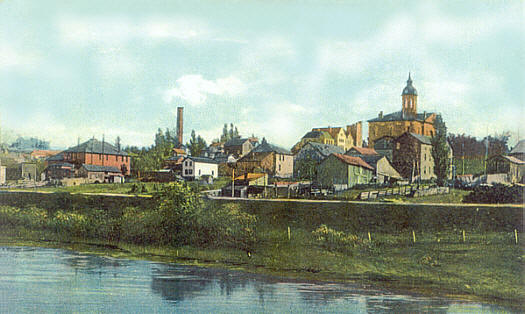 |
An old view taken from the O’Neill Creek Bridge; Visible is the Neillsville Brewery, the first standpipe in the back-ground, which collapsed in 1926, also, the courthouse and Wisconsin (Foster) Hotel on the right side, and in the foreground, O’Neill Pond, where ice was obtained for brewery needs.
 |
Neillsville Brewery at left, in the background, behind the electric pole and the Schroeder house is right foreground.
(Photo courtesy of Doris Simonson)
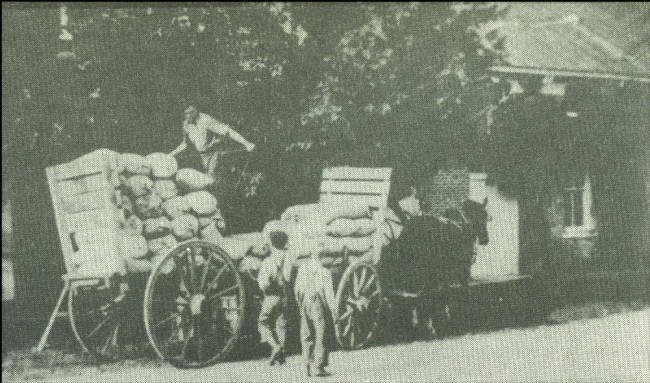 |
Photographed in 1913, Jack Lightfoot unloading barley at the Neillsville Brewery. Also Gerhardt and Rudy are pictured. (Photo courtesy of Doris Simonson)
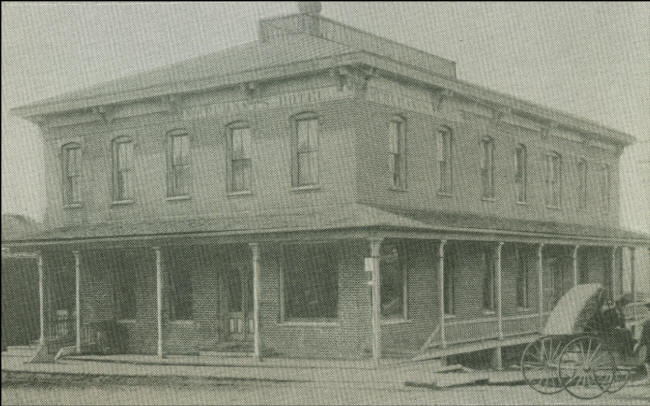 |
Merchants Hotel – Circa 1890-1900 in horse and buggy days, taken before the west addition, with the old east porch still intact as of this date (Thanks to Clark County Historical Society for photo).
¤¤¤¤¤¤¤¤¤¤¤¤¤¤¤¤¤¤¤¤¤¤¤¤
Compiled by Lori Liddell
25 years ago
Chili dedicates sewage system. Chili residents planned to celebrate their long-awaited sewage disposal system at formal dedication exercises Wednesday night.
The $115,000 project on which construction as started last Sept. 13 was to be completed, except possibly the final details, by the time of the dedication ceremonies. However, the probability early in the week was that it would not be in full use until later in the week.
|
© Every submission is protected by the Digital Millennium Copyright Act of 1998.
Show your appreciation of this freely provided information by not copying it to any other site without our permission.
Become a Clark County History Buff
|
|
A site created and
maintained by the Clark County History Buffs
Webmasters: Leon Konieczny, Tanya Paschke, Janet & Stan Schwarze, James W. Sternitzky,
|