|
|
|
Clark County Press, Neillsville, WI February 9, 1994, Page 28 Transcribed by Dolores (Mohr) Kenyon. Index of "Good Old Days" Articles
|
|
|
|
Clark County Press, Neillsville, WI February 9, 1994, Page 28 Transcribed by Dolores (Mohr) Kenyon. Index of "Good Old Days" Articles
|
Good Old Days
By Dee Zimmerman
The communities of Greenwood and Loyal started developing with new businesses in the early 1870’s.
References to the new establishments were made in the county newspaper.
August 1873:
“A visit of a couple of hours at Greenwood last week, gave us a very favorable impression of that enterprising little town. The sound of the hammer and saw are telling its future very plainly and the fall of surrounding trees corroborate their story. The leading mercantile establishments now are those of Chandler and Brown, which takes the lead. Honeywell & Son also keep a good general stock. The Eaton Bros. are putting up a large building in which they will know how to keep a good hardware store as well as any good man living.
Though still unpretending, we could not pass Sam Green’s establishment, which would still be an institution worth visiting if set down in the middle of Chicago. Sam is a genius and a philosopher as well, which later also is Mrs. Sam. Contented with contentment, they have invested the entire fortune they brought back from California in the gun business. Once again, Sam is found at the lathe and bench, in a community that appreciates him, judging from the seeming amount of work he had on hand. It could hardly be otherwise, for he is a good workman with good and increasing facilities for doing his work.
Mr. Begley keeps an excellent hotel which will make Greenwood a place of a thousand inhabitants when everything else is in keeping with it.
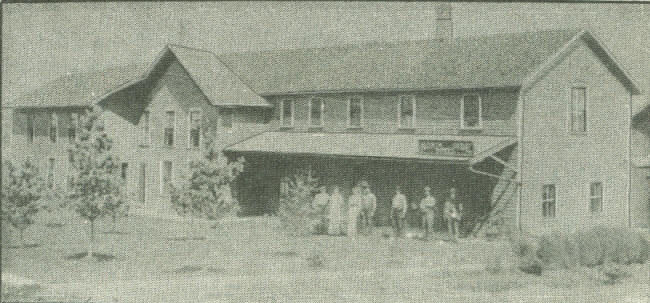 |
The North Side Hotel, better known as the Begley Hotel, was as the name indicates, located on Greenwood’s North-side. For several years, it was the only hotel in the village. Mr. Begley was an early resident of Clark County, one of its pioneers. As well as the hotel business, he was extensively involved with the lumbering business and farming.
Chandler & Brown are preparing to put up a large building beside their store to be used as a warehouse. A building which will accommodate a meat market is nearly completed. There are other buildings in various stages of erection, and strong indications of more to be built in the near future. The town is having a healthy growth, and will be at no distant day a place of considerable importance.
The people of Greenwood and vicinity have at least got a good bridge, or rather three good bridges, across the three channels of Black River, at Schofield’s mill. The bridges are all substantially built, and will meet the wants of the community for many years. A road running in a direct line from a little south of Chandlers’ store, in Greenwood to the bridge, has been cut through, and will soon be put into good traveling condition.
The old Eaton mill, near Greenwood, has been completely remodeled by its present owners. New additions, which comprise about half the mill, have been attached to the south and west sides. New machinery of the best make with additions, have replaced the old equipment. The mill contains one double rotary saw, an edger, a planer, a shingle mill, lath saws, etc. The capacity of the mill will be 40,000 feet a day. The dam is also to be rebuilt just below the old dam, with an increased head of water.
Mr. Schofield, who is presumed to know a thing or two about mills, has it in his head that whatever is needed, about the mill to increase its capacity equal to its growing wants, shall be supplied.
In connection with the mill, on the opposite side of the main dam, Mr. Bailey, who has shown his superior workmanship in flatting up the mill, will soon put up an extension sash, door and blind factory. Though separate establishments, this and the mill together will be able to turn out a house as nearly complete as can be done by machinery, and as such things are in demand, they will be patronized and appreciated.
The Greenwood Gazette made its appearance on Tuesday, August 5, 1873. It is a small four column sheet, containing considerable reading matter, and very neat in appearance. Mr. Carpenter announces in his salutatory that the paper will be independent in politics, with a slight leaning toward Republican. For the opportunity of the publisher, the paper is very creditable, and we think a credit to Greenwood. The subscription price is but 50 cents per year.
Greenwood wants a church. A long talked of camp meting, at Greenwood, is in full blast. Many from that place intend to be present on Sunday.”
August 29, 1873:
“The camp meeting at Greenwood was very largely attended by people from all parts of the country, last Sunday. The camp was located in a most beautiful piece of maple woods a half mile east of the village. We were in attendance and listened to several excellent sermons during the day and evening. It is certain that Greenwood will soon have a church or two. Mrs. Pounder provided an excellent supper.
We understand that Mr. W. H. Begley and others will put in another stage line between Neillsville and Greenwood. There will be two stage lines each day.
More boardwalks have been added, as improvements to Greenwood. The new walks have been placed in front of the new business buildings.
Chandler & Brown have finished improvements on their main building that was lengthened considerably with a very neat post office arranged in the back end. A store house has been put between the store and saloon, making it a solid block. They also added a tin-shop to the establishment, furnished with the necessary machinery.”
The circuit preachers traveled through the Greenwood area with services at summer camp meetings, log schoolhouses, homes, and out at the logging camps until congregations developed and church buildings were put up.
The first church to be built was the Methodist, in 1877, later selling the building to the United Lutheran Society in 1902. They sold the church building after erecting a new facility for their congregation in 1902. Other denominations came into the area shortly after.
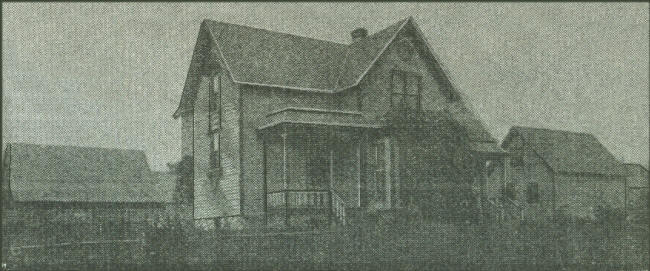 |
The James Bryden farm, property in the Town of Warner, was located adjacent to the Village of Greenwood. Established in c.1880, the farm consisted of one hundred and sixty acres with all but forty acres cleared and tillable. The farm house was well built, with hardwood floors, the decorative hardwood interior finishing and Victorian exterior trim, a showplace for that time. Bryden was a native of Nova Scotia, who came to Clark County as a young man, where he worked in lumbering. He then became involved in farming, having it stocked with many head of quality livestock.
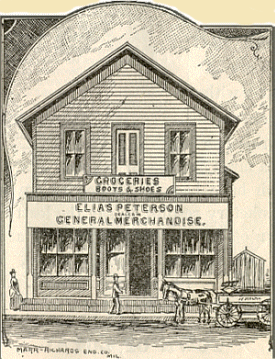 |
Greenwood Store of Elias Peterson in Greenwood: Peterson came to Greenwood Village in 1871, he started a shoe shop which was destroyed by fire in 1878. He then rebuilt the shoe store. An 1885 fire destroyed nearly the whole village with Peterson’s shop again being razed. In 1886, he built a store, selling general merchandise.
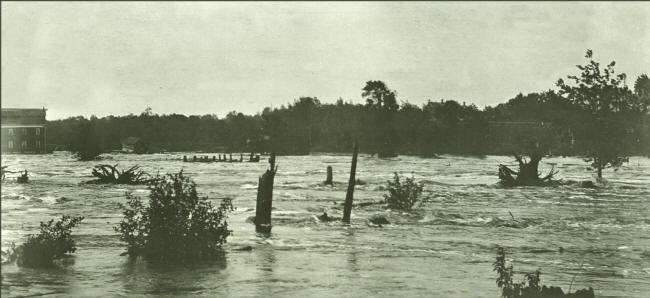 |
This photo depicts the 1914 flood and what little remained of the Hemlock Dam located about four miles north of Greenwood on the Black River. During the dam’s existence, a highway went over the dam and was used until a steel bridge was erected a short distance below the dam site. Hemlock was once a community, with a boarding house, a little store run by Baxter Shaw, two houses and two other old shanties. A Mr. Limprecht, who was a millwright, had operated a Withee mill at Hemlock when the flood happened. Limprecht claimant that the best fishing hole, ever, was in the pond which was formed with the water backed-up by the Hemlock Dam. The 1914 flood also destroyed that fishing pond.
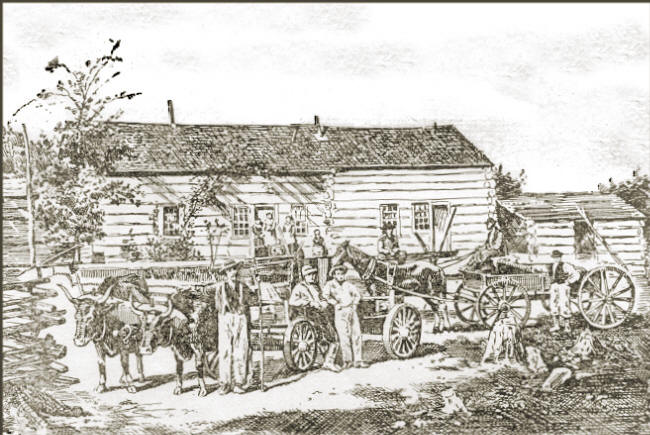 |
“The Dirty Shirt Farm” was owned and occupied by the Harry Mead family. Located about six miles north of Greenwood, along Hwy. 73, the pioneer log house was the first in that area. Mrs. Mead laundered clothes for the loggers, saving her earnings until she had enough money to buy the farm. The story was told that her husband had a weakness for poker, so her strong desire to help buy some farmland prevailed by her laundry service earnings. In 1873, the turnpike had been extended from Neillsville, as far as the Mead farm.
More Information (on William Harrison "Harry Mead").
Mead Township (Named for William Harrison Mead)
Mead, Julia A. (History - 1842) (Wife of William Harrison Mead)
|
© Every submission is protected by the Digital Millennium Copyright Act of 1998.
Show your appreciation of this freely provided information by not copying it to any other site without our permission.
Become a Clark County History Buff
|
|
A site created and
maintained by the Clark County History Buffs
Webmasters: Leon Konieczny, Tanya Paschke, Janet & Stan Schwarze, James W. Sternitzky,
|