Clark County WI
Civil War Unit Histories
Compiled by Paul Forester, Janet Schwarze, Allan Wessel & Ken Wood
QM 1st Brigade, Nashville
Our Civil War Veteran who fought with this Regiment
Phillip Rossman
The Battle of Nashville
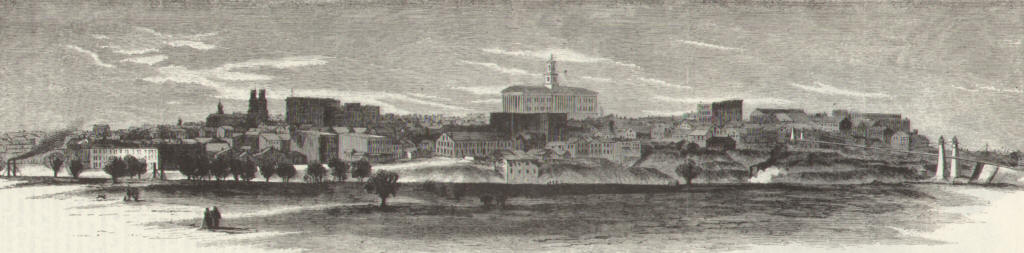
Nashville, Tennessee (1864)
Source: Harper's "Pictorial History of the Civil War" 1866
For two weeks prior to the Civil War Battle of Nashville, Tennessee, both armies were busy preparing for what became a decisive two day conflict. That second week of December of 1864, was so cold that both forces were completely ice-bound. The confederates, under the leadership of General John Bell Hood, were busy furnishing their troops with badly needed new supplies and shoes. The Union General, George Henry Thomas, spent his time perfecting his plans, remounting his cavalry, and strengthening his numbers with new recruits and temporary volunteers. The severe weather conditions had so delayed Thomas’s attack that his long silence apparently increased Hood’s confidence. It also led to considerable apprehension on the part of Lieutenant General Ulysses S. Grant, who being so far removed from that battlefield, lacked awareness of the rigorous conditions and how they hindered Thomas's plans. Nor did he comprehend the serious hardship suffered by the poorly-clad soldiers of Hood's army from the biting cold temperatures. Grant thought Thomas should have moved upon Hood as soon as possible and certainly before the confederates could replenish their supplies. From Grant's perspective, Thomas was clearly mistaken to delay until the cavalry was remounted.
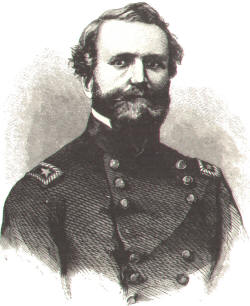
George Henry Thomas Union General
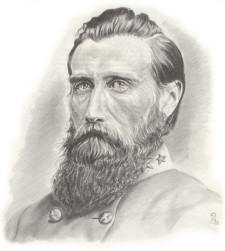
Confederate General
John Bell Hood
Source: Federal Archives
On Wednesday, December 14th, the temperatures rose and the severity of the weather began to relax. That afternoon, Thomas issued orders to his corps commanders for an advance against the enemy. His army was then 60,000 strong, and fully prepared for battle. Approximately 8,000 of those soldiers belonged to the Quartermaster's Troops, commanded by Brigadier General James Lowry Donaldson. Phillip Rossman from Sheboygan, Wisconsin who'd enlisted August 13, 1864, was one of Donaldson's newer recruits. The total Union Army was around 60,000, compared to the Confederates' 31,000.
Thomas's long delay appeared to have increased Hood's confidence. It also led to apprehension on the part of Lieutenant General Grant, who, at so great a distance from the field, was not aware of the rigorous cold which hindered Thomas's advance, and the a serious inconvenience the poorly-clad soldiers of Hood's army faced. He thought Thomas ought to have moved upon Hood immediately when those confederates appeared in Nashville, and before their provisions were fortified. From Grant's perspective, Thomas made a huge mistake by waiting to remount the cavalry before advancing his troops.
A large portion of the cavalry was still absent from the Confederate army. Hood was absolutely convinced of victory and had even dreamed of besieging Nashville. But the swollen river, patrolled by gun-boats, hindered an advance against the Louisville Road, and, even if this road had been reached and broken by the Confederate cavalry, Thomas was well supplied at Nashville with all that was necessary for either a defensive or offensive campaign.
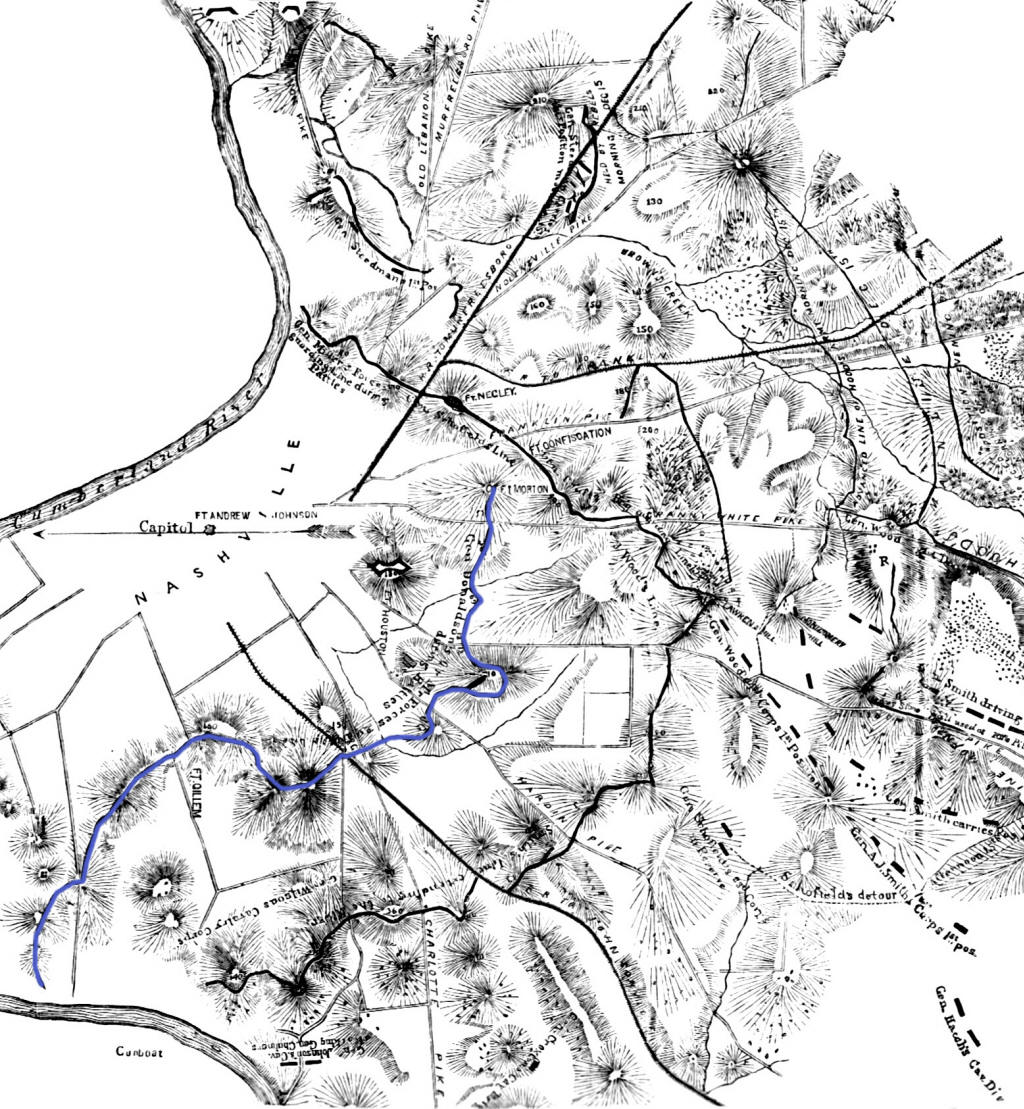
Source: Harper's "Pictorial History of the Civil War" 1866
(Click on the map to enlarge it) The Quarter Master's 1st Brigade Battle Plan for the Battle of Nashville
|
General Thomas's plan of the battle was very simple. It involved turning of the enemy's left flank by a sudden an unrelenting blow to be struck with the bulk of his army, employed until Hood's army was destroyed or dispersed in utter defeat. The quartermaster's troops, were slated to be posted on the interior Hue from Fort Morton to the battery on hill 210. Weather permitting, the troops would commence operations at 6 A.M. on Thursday, December 15th. As fate would have it, that day was extremely favorable to the immediate execution of General Thomas's plans. The sheet of ice which had covered the earth for nearly a week had broken up and the heavy mist had disappeared.
The first day's fight had been a simple matter of the Union forces bringing the pre-planned overwhelming power to bear upon the Confederate forces. For example, when one strategic Confederate outpost manned by 148 soldiers and 4 cannons resisted more than expected, the Union regrouped and attacked the outpost with 28 cannons and 7,000 soldiers.
It took a good share of Friday morning for the Federals to move into position against Hood's new line. Thomas had planned a two-phased attack, concentrating on Hood's left flank. Like clock work, Thomas' cavalry swung to the rear and blocked the Franklin Pike, Hood's only remaining route of withdrawal.
The Union troops basically destroyed John B. Hood's Army of Tennessee in just two days. The execution of Thomas' plan was so perfect in every detail that it justly conferred upon him the first rank among the Union generals as a tactician. A few weeks following that decisive victory for the northern forces, many of the Union Soldiers returned home, as did private Phillip Rossman who was mustered out on January 13, 1865.
The renowned Civil War Historian, Shelby Foote wrote:
"Much was expected. In downtown
Nashville, five days ago, the Virginian
had said more or less the same thing to
his chief subordinates when they
assembled in his quarters at the St
Cloud Hotel on December 10, midway
through the ice storm, to receive
preliminary instructions for the attack
they would launch as soon as the
rebel-occupied hills to the south
unfroze enough for climbing. Close to
twenty miles of intricate Federal
entrenchments stretched from bend to
bend of the Cumberland, including seven
that ran in a secondary line a mile
behind the first-line right and center,
manned by the 8,000 garrison and service
troops under Chief Quartermaster J. L.
Donaldson, a fifty-year-old West Pointer
who had been awarded the brevet rank of
brigadier. When the jump-off came, these
would move forward and take over the
works in their front, simultaneously
guarding against a counterstroke and
freeing well over half the 54,000 combat
soldiers now arrayed in a long arc, east
to west, under Steedman, Schofield,
Hood, A. J. Smith, and Wilson, for the
assault and the pursuit that was to
follow the dislodgment. First off,
Steedman would feint against the enemy
right, drawing Hood's attention away
from the main effort, which would then
be made against his left by Smith and
Wood in a grand left wheel, with
Wilson's troopers shielding the outer
flank and Schofield's two divisions
waiting in reserve to be committed in
either direction. Thus, with Donaldson's
and Steedman's men employed on the
defensive and the remaining 48,000
available for offensive use against
barely half their number, Thomas had
been able to plan something more than
the usual massing of troops for a
breakthrough at a single point. Instead,
his line of battle would be of
practically equal strength throughout
its length as it swung forward gatelike,
south and southeast, inexorably
crunching whatever it encountered. In
this way, once a thaw set in, the
ponderous Virginian intended not only to
defeat Hood, there on the ground where
he stood, but also to destroy him in the
process."
Source: The Civil War,
A Narrative, Red River to Appomattox;
Random House Publishers 1974. The Battle of Nashville Statistics by Crystal Wendt
Federal outer line, December 16, 1864
Other Wisconsin Companies that fought in this battle The 8th, 14th, 24th, 33rd, 44th & 45th.
Related Trivia
A Thousand Shirts--Upon Hood's retreat from Nashville, in December of 1864, many of his soldiers lost all of their clothing, and for many weeks quite a number were scarcely able to cover their nakedness, anything available being appropriated, and used as a substitute for the regular uniform. One day, while Hood and his staff were on the march, they overtook a regiment, and among the soldiers was one whose uniform consisted of only a long coffee sack, in lieu of a shirt, and with nothing else on. A hole had been cut for his head as also for his bare arms, and over this garment was suspended his canteen, and around him his cartridge belt, while he carried his musket as is usual.
Observing this novel sight, Hood reined up his horse, and demanded his name and regiment. "Martin Brown, Company I, Texas," was the prompt response of the soldier. "Well, have you no better uniform than that?" The soldier laid down his gun, looked the General straight in the face, and as the blood rushed indignantly to his cheeks, he said: "Look here, General Hood, do you expect a man to have a thousand shirts?" Rev. Theodore Gerrish and Rev. John S. Hutchinson.
Sources: Harper's "Pictorial History of the Civil War" 1866, Federal Archives, 1918 Clark Co., WI History, 1885 Special Wis. Veteran's Census, Clark Co., WI Veteran Grave Registrations, Civil War Military Records, "Civil War Treasury of Tales, Legends and Folklore" by Botkin.
Related Links Burials of Greenwood, Wisconsin Civil War Soldiers. |